

Micro Fiction
What is a Micro Fiction?
Micro Fiction is, at its most basic, a story told with few words. In a world where writers can be obsessed with their word counts, micro fiction or micro stories stand as a testament to the idea that storytelling really has no limits, or expectations. For writers it can take seconds or months to craft just one; and I would even personally argue that micro fiction is harder to practice than other formats of fiction.
For a more concrete, less vague definition, micro fiction is often cited as being under 300 words in total length. This makes it, technically, a sub-set of flash fiction for some but here at Lore Publication, we consider anything below 250 words micro fiction.
What is key to note here, and what makes micro fiction unique, is that unlike other written formats like poetry, micro stories don’t need to follow a particular structure. If anything, micro storytelling should retain the structure and format of ‘regular’ length fiction.
Micro Fiction History
For the nerds out there (like me), the history of the micro format of fiction is intriguing. The term itself is a more modern phrase that was coined by Jerome Stern in 1996 when he published his anthology Micro Fiction: An Anthology of Really Short Stories. This was the first instance in modern times where the term for a pre-existing sub-genre was introduced to the public consciousness.
This coining of the term was more a modern re-framing of an existing idea within storytelling circles, an idea that had been around since before humanity could write.
The ancient origins of micro fiction have their root in fables, stories, anecdotes, and tales – such as the word-of-mouth stories in Celtic folklore, Aesop’s Fables from Greece, or the Jataka Tales from India. All these are examples of prehistoric ‘micro fiction’ that existed long before the modern day term.
With that understanding, many of the 20th century’s literary pioneers helped pave the way for the modern concept of micro fiction in the 1900s to 1950s. Famous writers such as Félix Fénéon with his three-line novellas, the Cosmopolitan magazine with its short-short story, or Ernest Hemingway with his famous six-line micro fiction:
“For sale: baby shoes, never worn.”
All contributed to cementing the idea of micro stories as people across the world became more literate.
In the 21st century, a more dogmatic structure has been applied to fiction (especially where word count is concerned) which led to it being classified as its own format of fiction. This has even led to other sub-genre terms being coined such as ‘nano-fiction’ which is often cited as being under 50 words.
This leads us on nicely to:
How to write a micro fiction story
It’s a simple question but, the more you approach it, the harder it becomes to answer. Unlike in longer works of fiction (even flash fiction), micro stories leave little to no room for any kind of character building or development. Similarly, you can forget about in depth world building.
Micro stories are challenging to write because they rely heavily on a reader’s assumptions about the world and understanding of reality.
There’s no space in the word count to explain your detailed fictional world, or to ease your reader into foreign concepts and ideas. All you have to work with are universally understood ideas that you think your reader will already possess.
This is why Ernest Hemingway’s micro story above works so well; everyone knows what a baby is and everyone can understand there must be a story behind why the baby’s shoes haven’t been worn. Most importantly, the sentence conveys emotion to the reader and suggests the idea of hardship for the parents. Why do they need to sell the shoes? Were the shoes too big? Were they a gift? Did their child die? Or do the shoes simply not fit?
When it comes to writing your own fiction of this style, there are a few decisions to make before you write (which is counter-intuitive). Many writers simply write for the sake of writing, and maybe publishing comes later.
With micro fiction you need to:
- Make a conscious choice to decide what you want to write about.
- Decide who you are writing for before you pen ever touches the paper.
Your culture, society, gender, sex, and everything that makes you who you are will impact the kind of micro stories you create. In essence, micro fiction and stories bridge the gap between conventional fiction and conventional poetry.
How to outline micro fiction
Unlike traditional fiction, be it a full-length novel or a flash fiction, you’ll find it quite difficult to start writing without an explicit idea of where it is going. Longer works of fiction give you more room to explore your characters, setting, and plot as you meander your way to the story’s climax. This is untrue for works of the micro format. There’s no room to do any of this during the writing process.
That means, to write in the micro format, you need an explicit outline to assist you.
Teaching you how to outline micro fiction is more about helping you realise:
- A good vocabulary is your greatest tool.
- A firm understanding of grammatical structures can easily help you prune purple prose.
- Choose the language you write in wisely.

Vocabulary
Having an in-depth vocabulary will help you find unique words that can convey succinct meaning. Now, I don’t mean go away and study rare words for months on end (unless you really want to). A good thesaurus is a fantastic resource you could easily have to hand. As a personal note, try to find a modern thesaurus but don’t be afraid of more historic ones. Old, under-utilised words are often redacted from modern iterations of thesauri if they fall out of common use. Our dictionaries and thesauri update as our use of the language does.
Grammar
Much like with vocabulary, having a firm grasp on grammar – and where to use it – can help you trim words you don’t need. Again, that doesn’t mean going away and becoming a linguist, but it does mean knowing the difference between using a dash and using a comma; or when a semi-colon is needed versus when it isn’t. If you don’t already know a few basic rules of Grammar for your language, go learn them, and then choose a Grammar style. Do you like the Oxford comma? Or is it an extra character in your micro story you don’t want or need?
Language
This may seem an obvious one, but hear me out. English is widespread but it can also be reductive, especially if you have a native language that isn’t English. As a Scottish person, my great maternal grandparents only spoke Scots’ Gaelic. In Gaelic there are certain ways of saying things that changes the meaning. For instance, we don’t say “I love you” in Gaelic, we say “my love is at you” or “my love is on you”. Even such a small change re-frames how your love is to be understood. With that said, for micro stories, how languages are understood warrants serious consideration for they can condense and merge ideas.
The Architecture of a Micro Story
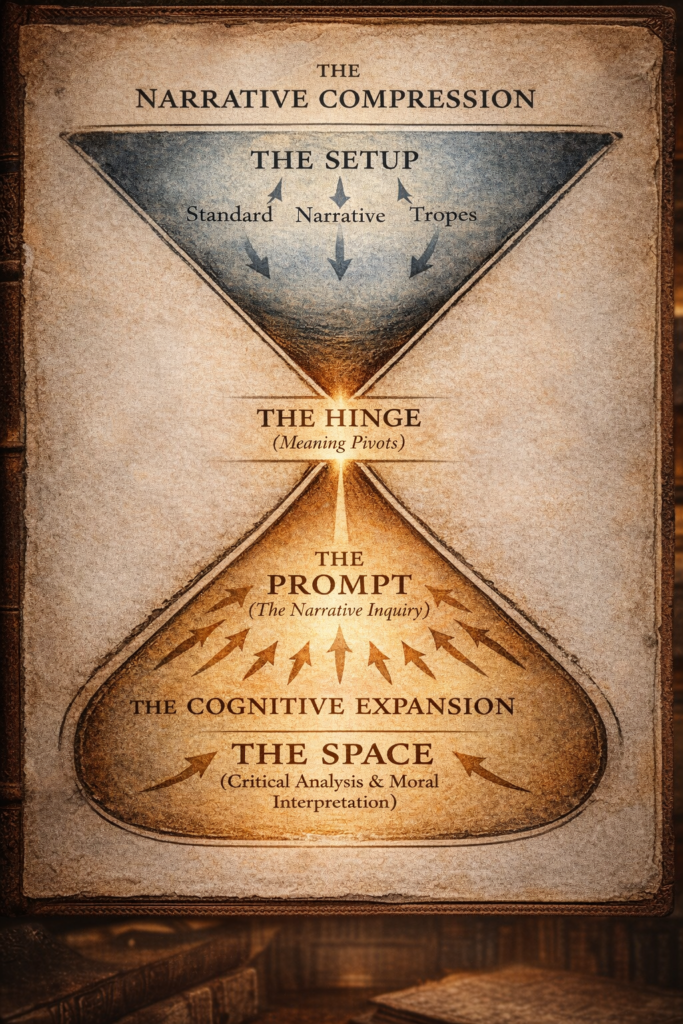
These tools will only take you so far along the yellow-brick road to crafting your own micro fiction. When it comes to stories written in this format, it is important to understand that they often follow a similar architecture. Much like a novel often has a three act structure, stories of micro fiction will have three core components:
- They have a hinge. Some people call it a ‘turning point’ or ‘the turn’. This is micro fiction’s equivalent to a ‘twist’ towards the end of a novel. In stories that are micro in length, the hinge is where the story’s meaning changes. See the examples below, particularly The Gift by Brian Newell. The story it goes from romance to threat very quickly.
- They prompt. Much like you might prompt an AI tool, or a smell might prompt a memory, in micro fiction the stories seldom give you a conclusion. Instead they prompt you to think more deeply about the surrounding narrative.
- They give space. This prompting of the reader launches them into a space where they think critically about the words, their intentions, and what the true moral or meaning of the story is.
Micro Fiction Examples
Aside from the Ernest Hemingway micro fiction mentioned above, here are some other famous examples:
“The last man on Earth sat alone in a room. There was a knock on the door…” – Knock, by Fredric Brown (1948)
“He was a great guy, until he wasn’t. Then he was a guy who used to be a great guy. Then he was just a guy. Then he was gone.” – George Saunders
“God said, ‘Cancel program.’ System error.” – Arthur C. Clarke
“Everything was fine. Then I saw him. Then everything was fine again. But for a moment, it wasn’t.” – Lydia Davis
“We are both sixty. He has been sixty for a year. I have been sixty for a month. We have both been sixty for a month.” – Lydia Davis
“The anniversary dinner was perfect. The wine was chilled, the steak was tender, and the candle flicker was romantic. ‘I have a surprise,’ he said, reaching into his pocket. He pulled out a small velvet box. Inside was a single, silver bullet. ‘It’s for you,’ he whispered.” – The Gift, by Brian Newell.
More from Lore Publication
Thanks for reading this far, and I hope this pseudo-essay helped you come to grasps with the micro fiction format. Here at Lore we do all kinds of cool stuff from publishing stories from writers all across the globe, to writing articles that’ll help writers hone their craft.
If this interests you, why not check out:
- Our short fictional work. Read stories from writers all across the world, for free!
- Why not take a look at our only commercially published work, a poetry collection ‘Nihilist’s Bible’ from our Founder, Stewart.
- Or if you are looking to hone your craft, take a look at our blog.
Have a submission for Lore? Check out our submission guidelines. Have a great day!
Useful Links
- Novels in Three Lines by Félix Fénéon
- Micro Fiction: An Anthology of Really Short Stories by Jerome Stern
Micro Fiction FAQs
What is the difference between flash fiction and micro fiction?
Modern writers and publishers often use the two terms interchangeably. The primary difference is in word count and structure. Flash fiction is often used as a “catch all” type term for fiction under 1000 words by most. Micro fiction defines a much tighter limit on word count of under 300 words (or under 250 words at Lore).
Why is micro fiction so difficult to write?
Micro fiction can be challenging to write because it lacks room for plot, character, or scene development like longer fiction. Instead, micro fiction relies on the hinge, or the twist, that recontextualizes the story or meaning. It requires the reader to fill in the gap of the narrative “iceberg” using their own assumptions and critical thinking.
What are the three components of a micro story?
Successful micro fiction follows a specific architecture:
- The Hinge: A moment where the meaning shifts.
- The Prompt: An ending that leaves the reader questioning.
- The Space: The psychological “white space” where the reader interprets the moral or outcome.
Is the Hemingway ‘Baby Shoes’ story real micro fiction?
Yes. It is one of the most famous examples of micro fiction. By today’s definitions, some people are calling it nano-fiction. While complete attribution to Hemingway is debated by scholars and writers alike, what is undeniable is its status as a work of micro fiction.
Can micro stories have a plot?
Yes, however, instead of the common three act structure you’ll see in novels the plot of a micro story is often implied. The arc, conflict, and resolution often happen in the mind of the reader than on the page. This arc is often heavily influenced by the writer’s vocabulary and grammar.