
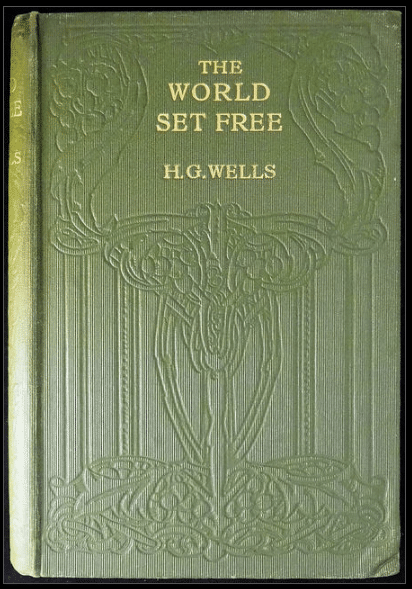
The World Set Free by H. G. Wells is a science fiction novel that is as ambitious in its vision as it was a reflection of Wells’ anxiety around human nature. For a text written over 100 years ago, it does a fantastic – almost prophetic – job of predicting atomic warfare. But, on a deeper level, this book is more a critique of the human ego. The World Set Free stands as a cautionary tale of what the ego can do with these newly fashioned and imagined “atomic machines”. It is a warning about the destructive potential that can be unleashed when immense power collides with human pride, ambition, and moral immaturity.
For a book that is preoccupied with warning its audience of the impeding doom that can easily be brought about by the mishandling of atomic weaponry – and markets itself as such – it starts in an unusual place for a 21st century reader. The choice to begin with humanity, and the storyteller, is an interesting one but as I read more I understood the ‘why’ behind this choice.
Keeping It Relatable
Before exploring these themes further, I do want to highlight how The World Set Free is very much a product of its time – just not in a bad way. The story begins by giving a detailed account of human advancement up until the early 20th century. This appears to be more of a strategic storytelling tactic employed by Wells to keep the book relatable, while also providing the pre-text for the science fiction concepts to follow.
This build up of established scientific knowledge helped construct a picture of human advancement for the layman who – in reality – likely didn’t have access to the same texts about human advancement as professors and educators. As I read further into the book, I was reassured that this build up was necessary for the layman of the time to understand the concepts explored later in the text. For without a firm understanding of how society reached their present day, the layman would struggle to comprehend the extrapolation of these ideas into the near future (solely due to how undervalued and restricted university education was in the early 20th century).
While it reads more like an academic paper in the first few sections, the theme of human exploration, wonder, and creativity are prominent and championed as the driver of societal, cultural, and technological evolution. To an extent, bias aside, I do agree with this sentiment as a generalised claim. But Wells takes this idea as the genesis point of human advancement and also highlights how this can also be malicious in bad actors. He does a good job of highlighting how this malicious nature to the human ego has been evident throughout history, or as far back as historians of the time could chart. That’s what makes the sections exploring their future from the not-so-rosy 1919 so enticing, even today in 2026. Everyone knows what the human ego is capable of, and Wells used this in his introductionary sections to prime the reader for what he thought would come next.
The Atomic Boogyman
It can sometimes be easy to forget that The World Set Free was written in the shadow of The Great War, and it can be hard to separate the ideas presented in the book from this context. But H. G. Wells was able to present ideas of conflict, and the future of conflict, in a meaningful way through which visceral horror was avoided in favour of existential horror. It can be a guilty pleasure of writers over-emphasising dystopian tropes to drive home the body horror of war and the mental consequences of surviving such horrific conditions. While H. G. Wells does touch on these ideas, and does present the horrors of war, they are presented as a consequence rather than an environmental condition to be overcome.
This accomplished a focus on the existential threat of such atomic conflicts to humanity as a species, rather than the existential threat of death for the individual. It succeeded in casting the reader’s mind beyond “how would I survive that?” to “how would we survive that?” – helping the reader to question not only their own morality, but how every human ego is ultimately susceptible to maliciousness under the right circumstances. Wells then presents war as the circumstance through which humanity develops ass a consequence of technology outpacing moral maturity.
That is to say war never changes, but we do.
About Lore Publication
Lore Publication is a place where stories are told and talked about. We take pride in providing free fiction for all to read, whilst also exploring popular stories within the genres of science fiction, fantasy, and speculative fiction.
What to read more? Why not check out:
- Lore’s Science Flash Fiction
- Lore’s Science Fiction Short Stories
- Our blog, for more about writing and storytelling
- Our article on Artificial Intelligence Sci Fi Themes & Themes of Identity
FAQs About The World Set Free by H. G. Wells
What is the world set free about?
At its core, The World Set Free is about humanity discovering atomic energy, and developing weapons using this technology. However, the sub-text of the novel is about the human ego and moral immaturity.
What is the message of the world set free?
The novel has many interpretations, but most commonly The World Set Free is said to lay the groundwork that knowledge and power are limitless, and the essential driving forces behind humanity (as opposed to other aspects, such as love). However, the case that the book is more about the human ego and the consequences of technological advancements out-pacing moral maturity are also key morals or messages to consider.
Did HG Wells predict the atomic bomb?
Yes. In The World Set Free H. G. Wells wrote about a bomb that could be fuelled by atomic energy, that would burn for generations. While the general idea of an atomic bomb was correct, how the bomb actually functioned was not discussed in depth (with the descriptions of the bomb’s detonation varying wildly from reality).